
Author
Mega AIPublished
Mar th, 2026Category
GuidesThe franchise disclosure document is one of the most important legal documents you will encounter during your franchise buying journey. Whether you are a first-time investor or a seasoned entrepreneur evaluating a new opportunity, the FDD holds the answers to questions you may not even know to ask.
Ready to evaluate a franchise opportunity? Request your free franchise information package today.
This guide breaks down exactly what the franchise disclosure document contains, how to read it effectively, and what red flags to watch for before signing any franchise agreement.
Key Takeaway: A franchise disclosure document (FDD) is a legally required document that every franchisor in the United States must provide to prospective franchisees at least 14 days before any agreement is signed or money changes hands. The FDD contains 23 standardized items covering everything from franchise fees and litigation history to financial performance and franchisee obligations.
- The FTC mandates the FDD under the Franchise Rule, established in 1978
- You must receive the FDD at least 14 days before signing any contract or paying any fees
- The document is not a contract itself but a disclosure tool for informed decision-making
- Items 7, 19, and 20 are considered the most critical sections for investors
- A franchise attorney should review the FDD alongside you before you commit
What Is a Franchise Disclosure Document (FDD)?
A franchise disclosure document, commonly called an FDD, is a comprehensive legal document that franchisors are required to provide to anyone considering buying a franchise. The Federal Trade Commission (FTC) mandates this disclosure under the Franchise Rule, which was first established in 1978 to protect prospective franchise buyers from misleading or incomplete information.
The FDD is not a contract. It is a disclosure tool designed to give you a complete picture of the franchise opportunity before you make any financial commitment. Think of it as the franchise’s full transparency report, covering the company’s history, your financial obligations, the franchisor’s legal track record, and much more.
Every franchisor operating in the United States must deliver the FDD to prospective franchisees at least 14 days before any agreement is signed or any payment is made. Some states, including California, Illinois, Maryland, and New York, impose additional registration and disclosure requirements that go beyond the federal standard.
The FDD meaning in franchising is straightforward: it is the single document that compiles everything you need to evaluate whether a franchise investment opportunity is worth your time, money, and effort. When researching any FDD franchise opportunity, this document should be your starting point.
Why the Franchise Disclosure Document Matters for Investors
Understanding the franchise disclosure document is not optional if you are serious about investing in a franchise. Here is why the FDD should be at the center of your evaluation process.
It protects your investment. The FDD forces franchisors to disclose financial details, legal issues, and operational requirements that they might otherwise downplay during sales presentations. Without this document, you would be relying entirely on marketing materials and verbal promises.
It enables comparison. When you are evaluating multiple franchise brands, the standardized 23-item format of the FDD makes direct comparison possible. Every franchisor must disclose the same categories of information, which means you can place two FDDs side by side and identify material differences in fees, obligations, territory protections, and financial performance.
It reveals the real cost. Many first-time franchise buyers underestimate total investment costs because they focus only on the franchise fee. The FDD breaks down every category of expense, from initial buildout costs to ongoing royalties, advertising fees, and technology charges.
It surfaces risk. Litigation history, franchisee turnover rates, and financial performance data (when disclosed) give you a data-driven view of the franchise system’s health. A franchise due diligence guide can help you organize this analysis.
The 23 Items in a Franchise Disclosure Document Explained
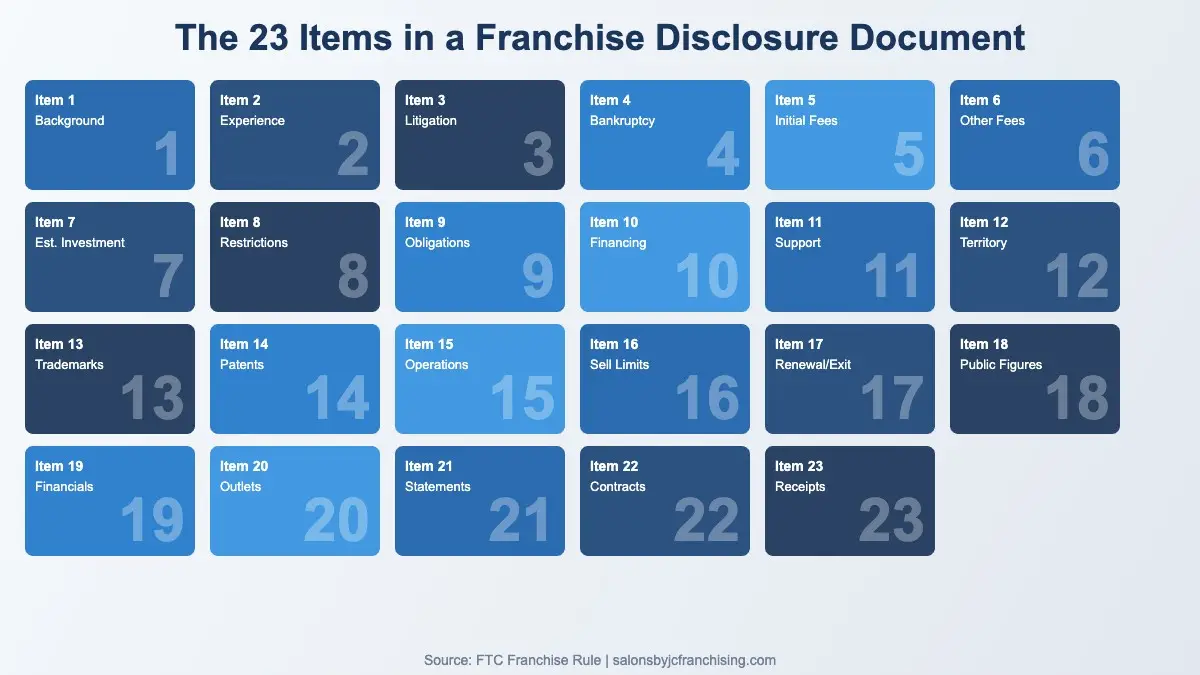
Every FDD follows the same 23-item structure mandated by the FTC. Here is what each item covers and why it matters for your investment decision.
Items 1-4: Franchisor Background and Legal History
Item 1: The Franchisor and Any Parents, Predecessors, and Affiliates. This section tells you who you are doing business with. It includes the company’s legal name, business structure, years in operation, and any parent companies. For example, a brand like Salons by JC, which has been in the salon suite industry since 1997, would detail its corporate history and structure here.
Item 2: Business Experience. This identifies the key executives running the franchise system and their professional backgrounds. Look for depth of franchising experience and tenure with the company.
Item 3: Litigation. This is your first major checkpoint. Item 3 discloses any lawsuits involving the franchisor, its executives, or its affiliates. A few lawsuits may be normal for a large system, but patterns of franchisee disputes or government actions should raise serious concerns.
Item 4: Bankruptcy. This reveals whether the franchisor or any of its executives have filed for bankruptcy in the past 10 years. Prior bankruptcy does not automatically disqualify a franchise, but it warrants deeper investigation into the company’s current financial stability.
Items 5-7: Fees and Investment Costs
These three items form the financial backbone of the FDD and deserve careful analysis.
Item 5: Initial Fees. This covers the franchise fee itself and any other upfront payments required before you open for business. Franchise fees typically range from $20,000 to $60,000 depending on the brand and industry.
Item 6: Other Fees. This is where ongoing costs are disclosed, including royalty fees (usually a percentage of gross revenue), advertising fund contributions, technology fees, transfer fees, and renewal fees. Read this section carefully because these recurring costs directly impact your franchise profit margins.
Item 7: Estimated Initial Investment. This is one of the most critical items in the entire franchise disclosure document. It provides a detailed table of every cost category required to open and operate the franchise through the initial period. This includes real estate, construction, equipment, signage, insurance, licenses, and working capital.
When reviewing Item 7, pay attention to:
– The range between low and high estimates (a wide range may indicate inconsistent costs)
– Whether real estate costs are included or excluded
– The working capital estimate and how many months it covers
– Which costs are paid to the franchisor versus third parties
For salon suite franchises, the investment breakdown typically includes leasehold improvements, architectural fees, and buildout costs that can vary significantly by market.
Items 8-10: Operational Restrictions and Financing
Item 8: Restrictions on Sources of Products and Services. This tells you whether you must purchase supplies, equipment, or services from approved vendors. Exclusive sourcing requirements can affect your cost structure and flexibility.
Item 9: Franchisee’s Obligations. This is a reference table that points you to specific sections of the franchise agreement where your duties are spelled out. It covers everything from training attendance to reporting requirements to quality standards.
Item 10: Financing. If the franchisor offers financing or has arrangements with third-party lenders, those terms are disclosed here. Many franchisors do not offer direct financing but may have preferred lending relationships.
Items 11-12: Franchisor Support and Territory
Item 11: Franchisor’s Assistance, Advertising, Computer Systems, and Training. This details what the franchisor provides before and after you open, including training programs, marketing support, technology platforms, and ongoing operational assistance. Strong franchise systems invest heavily in franchisee support programs. For example, brands that provide an onsite Concierge Manager or dedicated operational support demonstrate a higher level of commitment to franchisee success.
Item 12: Territory. This defines whether you receive an exclusive territory, a protected area, or no territorial rights at all. Territory provisions have a direct impact on your revenue potential. Ask specifically about online sales policies, national account exceptions, and whether the franchisor can place another location near yours.
Items 13-17: Intellectual Property and Operational Framework
Item 13: Trademarks. This confirms that the franchisor owns or has rights to the trademarks you will use. Verify that trademarks are registered with the U.S. Patent and Trademark Office.
Item 14: Patents, Copyrights, and Proprietary Information. Covers any additional intellectual property relevant to the franchise system.
Item 15: Obligation to Participate in the Actual Operation of the Franchise Business. This is critical for investors seeking a semi-absentee franchise model. Item 15 tells you whether the franchisor requires you to be actively involved in day-to-day operations or whether you can hire a manager to run the business. Salon suite franchise models, for instance, are often designed for semi-absentee ownership where a Concierge Manager handles daily operations.
Item 16: Restrictions on What the Franchisee May Sell. This outlines any limitations on products or services you can offer.
Item 17: Renewal, Termination, Transfer, and Dispute Resolution. Read this section thoroughly. It covers:
– How long your franchise term lasts and under what conditions you can renew
– Grounds for termination and what notice is required
– Rules for selling or transferring your franchise
– Whether disputes go to mediation, arbitration, or litigation
Understanding your franchise exit strategy starts with Item 17.
Items 18-20: System Data and Financial Performance
Item 18: Public Figures. Discloses whether any public figures are involved in promoting or managing the franchise.
Item 19: Financial Performance Representations. This is the item most investors look for first, and for good reason. Item 19 is where franchisors can (but are not required to) disclose financial performance data such as average revenue, profit margins, or earnings.
Key points about Item 19:
– Not all franchisors include financial performance representations
– If a franchisor does include this data, it must have a reasonable basis and supporting documentation
– Pay close attention to the footnotes, which define what is included and excluded
– Ask whether the data represents all locations, top performers, or a specific subset
– Compare Item 19 data to what current franchisees actually report
A strong Item 19, backed by transparent data, is a positive indicator. If a franchisor chooses not to disclose this information, ask why. Understanding franchise ROI requires looking beyond Item 19, but it provides an important starting point.
Item 20: Outlets and Franchisee Information. This section shows how many franchise units have opened, closed, transferred, or ceased operations over the past three years. It also provides contact information for current and former franchisees.
Item 20 is your validation tool. The numbers tell you whether the system is growing, stable, or contracting. Use the contact list to reach out to current franchisees and ask about their experience. Preparing the right questions for franchisees can uncover insights no document will give you.
Items 21-23: Legal and Financial Foundations
Item 21: Financial Statements. Requires the franchisor to include three years of audited financial statements. These reveal the company’s financial health, cash flow, and ability to support its franchise system. Have a CPA review these statements alongside you.
Item 22: Contracts. This is where you find the actual franchise agreement and all related contracts you will be asked to sign. Everything disclosed in the FDD becomes enforceable through these contracts.
Item 23: Receipts. The FDD includes a receipt page that you sign to confirm you received the document. Keep a copy for your records.
How to Read a Franchise Disclosure Document: A Practical Framework
Reading an FDD cover to cover is important, but knowing where to focus your attention makes the process far more efficient. Here is a practical framework for reviewing any franchise disclosure document.
Step 1: Start With Items 7, 19, and 20
These three items give you the financial picture. Item 7 tells you what it costs. Item 19 tells you what you might earn (if disclosed). Item 20 tells you whether the system is growing or shrinking. Together, they form the foundation of your investment analysis.
Step 2: Review the Legal History (Items 3 and 4)
Litigation patterns and bankruptcy history reveal risk factors that financial projections cannot capture. Look for recurring franchisee lawsuits, government enforcement actions, or executive-level legal issues.
Step 3: Understand Your Obligations (Items 6, 9, and 17)
Know what you will owe (Item 6), what you must do (Item 9), and what happens if things change (Item 17). These items define the ongoing operational and financial framework of your franchise relationship.
Step 4: Evaluate Support and Territory (Items 11 and 12)
Strong training programs, marketing support, and clearly defined territories are hallmarks of a well-run franchise system. Weak or vague commitments in these areas should prompt further questions.
Step 5: Talk to Franchisees (Using Item 20 Contact Lists)
The single most valuable due diligence step is speaking directly with current and former franchisees. Ask about their actual experience compared to what the FDD disclosed.
Red Flags to Watch for in an FDD
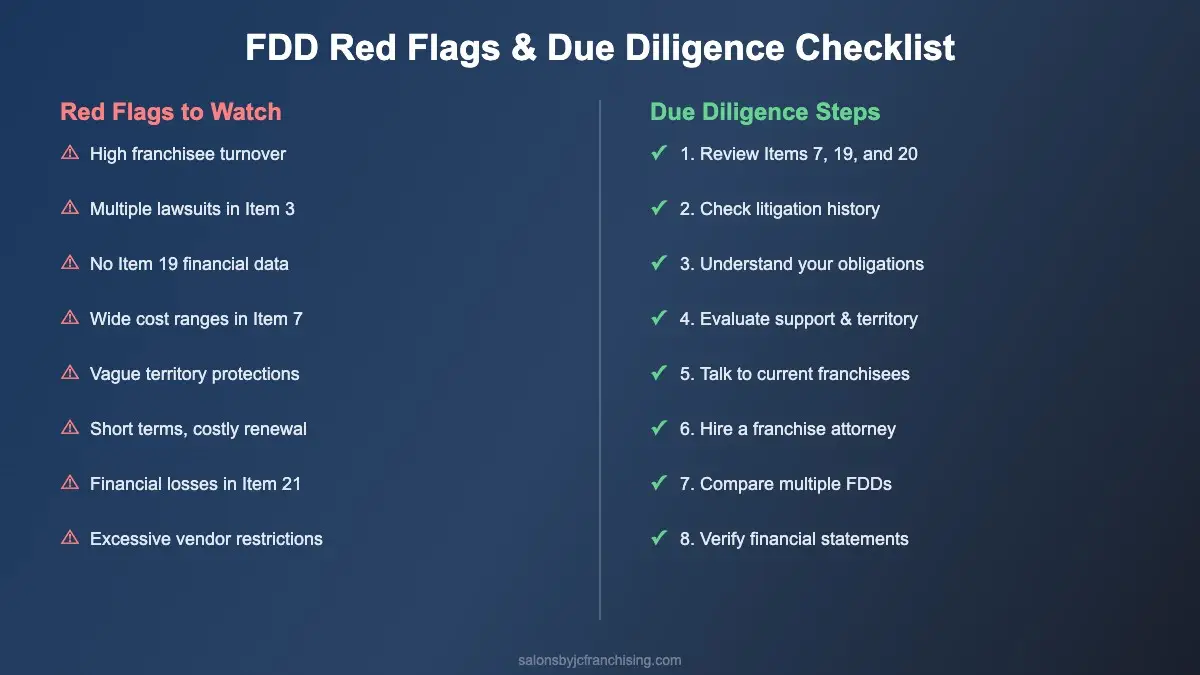
Not all franchise disclosure documents are created equal. Here are warning signs that should trigger deeper investigation or professional review.
| Red Flag | What It May Indicate |
|---|---|
| High franchisee turnover in Item 20 | Systemic issues with profitability or support |
| Multiple franchisee lawsuits in Item 3 | Pattern of broken promises or disputes |
| No Item 19 financial performance data | Franchisor may not want to disclose weak numbers |
| Wide cost ranges in Item 7 | Unpredictable buildout or startup costs |
| Vague territory protections in Item 12 | Risk of market saturation or internal competition |
| Short franchise term with costly renewal in Item 17 | Limited long-term value of your investment |
| Franchisor financial losses in Item 21 | System may not be sustainable long-term |
| Excessive mandatory vendor restrictions in Item 8 | Higher operating costs and less flexibility |
FDD and the Franchise Agreement: Understanding the Difference
A common point of confusion is the relationship between the franchise disclosure document and the franchise agreement. They are related but serve different purposes.
The FDD is a disclosure tool. It provides information so you can make an informed decision. It is not a binding contract.
The franchise agreement is a legal contract. Once you sign it, you are bound by its terms. The franchise agreement is included as an exhibit within the FDD (Item 22), but the obligations it creates take effect only when both parties execute it.
Always review the franchise agreement with a franchise attorney before signing. Terms in the agreement may differ from or add to what the FDD summary presents. Your attorney can identify provisions that may limit your rights or impose unexpected obligations.
Where to Find Franchise Disclosure Documents
Franchise disclosure documents are not always easy to access before you enter the formal discovery process with a franchisor. Here are your options.
Directly from the franchisor. The most common path. Once you express serious interest and submit an application, the franchisor is legally required to provide the FDD. You can request franchise information directly from brands you are evaluating.
State regulatory agencies. Several states require franchisors to register and file their FDDs with a state agency. States like California (Department of Financial Protection and Innovation), Minnesota, and Wisconsin make these filings available to the public.
Third-party databases. Services like FDD Source and Franchise Grade compile FDDs for research purposes, though access may require a subscription.
Franchise brokers and consultants. Experienced franchise advisors often have access to FDDs for brands they represent and can help you compare multiple opportunities.
The FDD Review Timeline: What to Expect
Understanding the timeline helps you plan your evaluation process.
| Stage | Timeline | What Happens |
|---|---|---|
| Initial inquiry | Day 1 | You express interest and submit an application |
| FDD delivery | Before Day 14 | Franchisor must provide the FDD at least 14 days before any agreement or payment |
| Review period | 14+ days | Your time to read, analyze, and consult professionals |
| Franchisee calls | During review | Contact current/former franchisees from Item 20 |
| Attorney review | During review | Franchise attorney reviews FDD and franchise agreement |
| Decision | After review | Sign the franchise agreement or walk away |
Some states require longer waiting periods. For example, Iowa requires a 14-day waiting period after any material changes to the FDD, and Illinois requires its own state-specific addendum.
Frequently Asked Questions About the Franchise Disclosure Document
What is a franchise disclosure document?
A franchise disclosure document (FDD) is a legally required document that every franchisor in the United States must provide to prospective franchisees. It contains 23 standardized items covering the franchisor’s background, fees, financial performance, legal history, and the terms of the franchise relationship. The FTC mandates the FDD under the Franchise Rule to ensure transparency in franchise sales.
How long do you have to review an FDD before signing?
Federal law requires franchisors to deliver the FDD at least 14 calendar days before you sign any agreement or pay any money. Some states impose longer waiting periods. Use this time to read the document thoroughly, consult a franchise attorney, and speak with current franchisees listed in Item 20.
Are franchise disclosure documents public?
FDDs are not universally public documents, but several states require franchisors to file them with regulatory agencies. States like California, Minnesota, and Wisconsin make these filings accessible. You can also request an FDD directly from any franchisor once you enter their discovery process.
What is the most important section of the FDD?
Items 7 (Estimated Initial Investment), 19 (Financial Performance Representations), and 20 (Outlets and Franchisee Information) are widely considered the most critical sections for prospective investors. Together, they reveal the cost of entry, potential earnings, and system growth trends.
Can you negotiate terms in the franchise agreement after reviewing the FDD?
Some franchise systems allow limited negotiation on certain terms, though many large franchisors present the agreement as non-negotiable. A franchise attorney can identify which provisions may be open to discussion and advise you on areas where negotiation is common.
What happens if a franchisor does not provide an FDD?
Failure to provide a compliant FDD is a violation of federal law. If a franchisor refuses to give you an FDD, pressures you to sign before the 14-day review period, or provides an incomplete document, consider it a serious red flag. You can report violations to the FTC.
Taking the Next Step in Your Franchise Evaluation
The franchise disclosure document is your most valuable tool for making an informed franchise investment decision. Read it carefully. Compare multiple FDDs. Talk to franchisees. And always work with a franchise attorney who can identify risks that may not be obvious to first-time investors.
If you are exploring franchise opportunities in the beauty and wellness industry, understanding the FDD is the first step toward evaluating whether a salon suite franchise investment aligns with your financial goals and lifestyle preferences. Every FDD franchise evaluation starts with this document. The semi-absentee franchise model offered by leading salon suite brands provides a compelling option for investors seeking scalable, rental-based income without daily operational involvement.
Ready to learn more? Request franchise information to receive a complete FDD and begin your evaluation process.