
Author
Mega AIPublished
Mar th, 2026Category
GuidesChoosing between a franchise and an independent business is one of the most important decisions an aspiring entrepreneur can make. Both paths lead to business ownership, but they differ significantly in risk, cost, support, and long-term potential. This guide breaks down the pros and cons of each model so you can decide which one aligns with your goals, budget, and lifestyle.
Ready to explore a proven franchise model with built-in support? Learn how Salons by JC makes franchise ownership accessible.
Key Takeaways: Franchise vs Independent Business at a Glance
- Franchises offer a proven business model, brand recognition, and structured support, making them lower-risk for first-time owners.
- Independent businesses provide full creative control and unlimited profit potential but come with higher failure rates and steeper learning curves.
- The franchise industry generates over $800 billion annually in the U.S., with nearly 800,000 franchise establishments.
- Approximately 70% of franchises survive past five years, compared to roughly 50% of independent businesses (SBA data).
- Your decision should be based on capital availability, risk tolerance, desired autonomy, and industry experience.
What Is a Franchise?
A franchise is a business model where an individual (the franchisee) purchases the right to operate under an established brand. The franchisee pays an initial franchise fee and ongoing royalties in exchange for the franchisor’s trademarks, operating systems, training, and ongoing support.
When you buy a franchise, you’re essentially buying a blueprint. The products, services, marketing strategies, and operational procedures are already developed and tested. Your job is to execute the model within your local market.
Key characteristics of franchise ownership include:
- Brand recognition from day one — customers already know and trust the name
- Comprehensive training and onboarding — franchisors provide systems to get you operational quickly
- Ongoing operational support — from marketing to supply chain management
- Standardized processes — proven playbooks reduce guesswork
- Territory protections — defined markets help prevent internal competition
What Is an Independent Business?
An independent business is a company built from the ground up by an entrepreneur without affiliation to a franchisor or parent brand. The owner creates everything: the brand identity, business model, operational procedures, marketing strategy, vendor relationships, and customer experience.
Independent business owners have complete creative freedom, but they also shoulder the full burden of building brand awareness, attracting customers, and developing systems from scratch.
Key characteristics of independent business ownership include:
- Total creative control — pricing, branding, product selection, and strategy are entirely yours
- No franchise fees or royalties — you keep 100% of your profits
- Flexibility to pivot — adapt your business model at any time without franchisor approval
- Unique market positioning — build a brand that reflects your personal vision
- Higher risk and responsibility — every decision, success, and failure rests on your shoulders
Franchise vs Independent Business: Side-by-Side Comparison
| Factor | Franchise | Independent Business |
|---|---|---|
| Startup Costs | $50,000–$500,000+ (clearly defined in FDD) | $5,000–$200,000+ (highly variable) |
| Ongoing Fees | 5–8% royalty + 2–4% marketing fund | None |
| Brand Recognition | Instant — established customer trust | Must build from scratch |
| Training & Support | Comprehensive systems provided | Self-directed learning |
| Business Freedom | Limited by franchisor guidelines | Complete control |
| Success Rate (5 years) | ~70% still operating | ~50% still operating |
| Time to Revenue | Faster — proven playbook | Slower — trial and error |
| Financing | Easier — SBA programs favor franchises | Harder — unproven concept |
| Profit Potential | Steady but reduced by fees | Unlimited upside |
| Exit Strategy | Recognized resale value, franchisor approval needed | Sell to anyone, anytime |
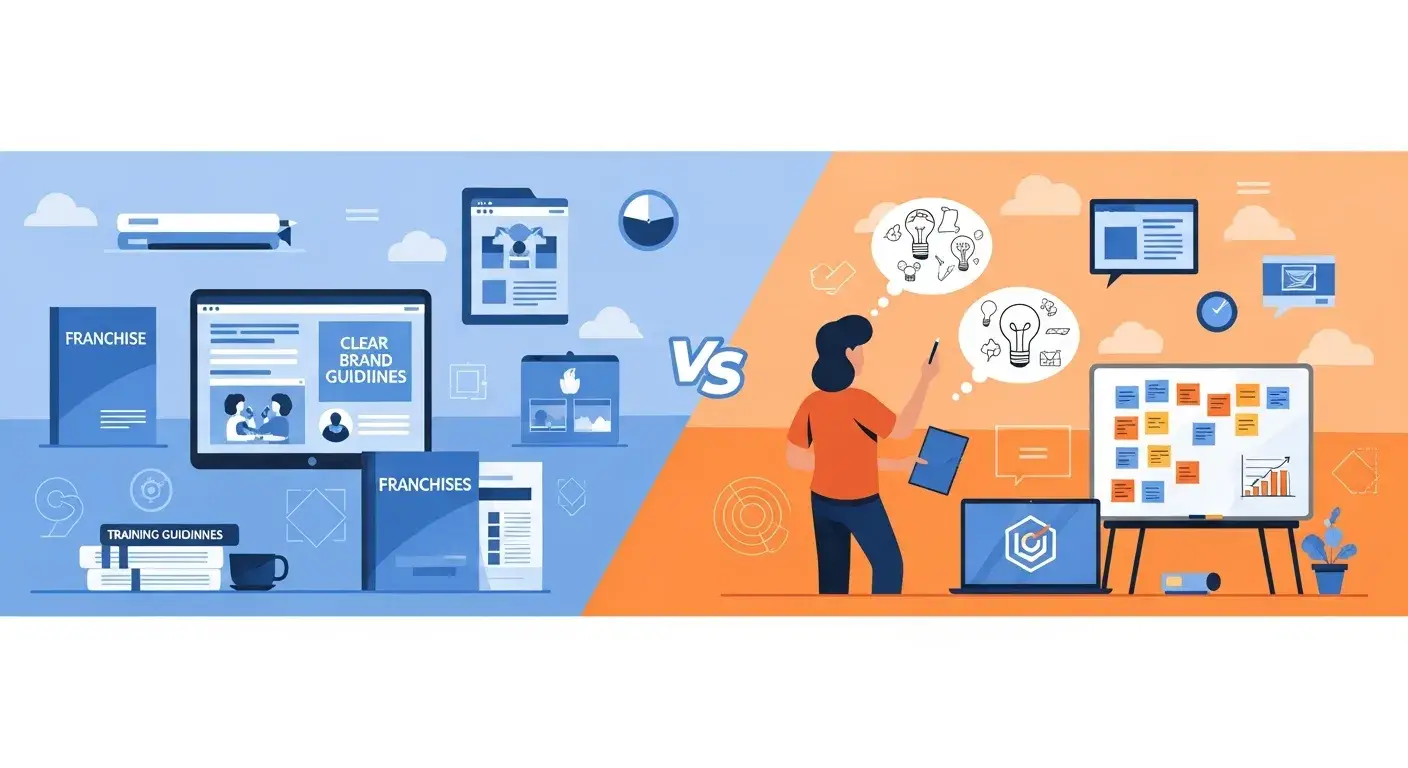
Advantages of Buying a Franchise
1. Lower Risk with a Proven Model
The single biggest advantage of franchising is reduced risk. You’re not inventing a concept; you’re investing in a model that has already been tested, refined, and validated across multiple markets. Franchise systems come with documented processes for every aspect of operations, from hiring to customer service.
According to the U.S. Small Business Administration, franchise businesses have significantly higher survival rates than independent startups. This is largely because franchisees benefit from systems that have already worked through the trial-and-error phase.
2. Built-In Brand Recognition
Building brand awareness from zero is one of the most expensive and time-consuming challenges for any new business. Franchise owners bypass this entirely. From the moment you open your doors, customers recognize your brand, trust your quality, and are already searching for your services.
3. Comprehensive Training and Support
Reputable franchisors invest heavily in training programs that cover every operational detail. Whether you’ve never managed a business or come from a completely different industry, franchise training prepares you to run your location confidently.
At Salons by JC, for example, franchisees receive hands-on training in real estate selection, buildout management, lease-up strategies, and daily operations — even if they have zero prior salon industry experience.
4. Easier Access to Financing
Lenders and SBA programs view franchise investments more favorably than independent startups because of the franchisor’s track record. Many franchise brands are on the SBA’s approved registry, which can streamline your loan application process.
5. Marketing and Technology Infrastructure
Franchisees benefit from national marketing campaigns, digital marketing tools, lead generation systems, and technology platforms they’d never be able to afford independently. This shared infrastructure gives franchisees a competitive advantage that would take years and significant capital to build on their own.
Disadvantages of Buying a Franchise
1. Less Creative Control
Franchise agreements require you to follow the franchisor’s established guidelines. You can’t change the branding, modify the product lineup, or deviate from approved marketing materials without approval. For entrepreneurs who value creative freedom, this structure can feel restrictive.
2. Ongoing Fees
Royalty payments (typically 5–8% of gross revenue) and marketing fund contributions (2–4%) are ongoing expenses that reduce your margins. Over a 10-year period, these fees can add up to hundreds of thousands of dollars, money an independent business owner would keep.
3. Contractual Obligations
Franchise agreements typically run 10–20 years and come with non-compete clauses, territory restrictions, and renewal conditions. You’re bound by these terms for the duration of the agreement, which limits your flexibility.
4. Shared Reputation Risk
Your brand reputation is partially dependent on other franchisees. If another location delivers poor service or generates negative press, it can affect customer perception of your business.
Advantages of Starting an Independent Business
1. Complete Autonomy
You make every decision: pricing, branding, product development, marketing strategy, and vendor selection. There’s no corporate playbook to follow and no approval process to navigate.
2. No Royalty Payments
Every dollar of profit stays with you. There are no ongoing franchise fees eating into your margins, which means higher profit potential if the business succeeds.
3. Unlimited Growth Potential
Independent business owners can pivot their strategy, expand into new markets, add product lines, or completely rebrand at any time. This flexibility allows you to adapt quickly to market changes.
4. Build Equity on Your Terms
When you build a successful independent brand, you own 100% of the equity. You can sell to anyone without franchisor approval and capture the full value of what you’ve built.
Disadvantages of Starting an Independent Business
1. Higher Failure Rate
The U.S. Bureau of Labor Statistics reports that approximately 20% of independent businesses fail in their first year, and roughly 45% fail within five years. Without proven systems, brand recognition, or corporate support, the margin for error is much smaller.
2. Steeper Learning Curve
Everything from operations to marketing to supply chain management must be figured out through trial and error. This learning curve is expensive, both in time and money, and often leads to costly mistakes that franchisees avoid thanks to established systems.
3. Building Brand Awareness Takes Time and Money
Marketing an unknown brand requires significant investment in advertising, SEO, social media, and community outreach. It can take years to build the recognition that a franchise provides from day one.
4. Limited Support Network
Independent business owners don’t have a franchisor to call when something goes wrong. You’re responsible for solving every operational challenge, from HR issues to supply chain disruptions, on your own.
Decision Framework: Which Path Is Right for You?
The best choice depends on your personal situation. Consider these five key questions:
1. What Is Your Risk Tolerance?
If you prefer a structured, lower-risk approach with proven systems, franchising is likely the better fit. If you’re comfortable with higher uncertainty and the potential for greater rewards, an independent business may suit you.
2. How Much Capital Do You Have?
Franchises typically require more upfront capital but offer clearer ROI projections. Independent businesses can start with less capital, but the total cost of building everything from scratch often exceeds initial estimates.
3. Do You Want Creative Control or Operational Support?
Entrepreneurs who value creative freedom and autonomy gravitate toward independent businesses. Those who prefer a proven system with built-in support tend to thrive in franchise models.
4. What Is Your Industry Experience?
If you’re entering an unfamiliar industry, a franchise’s training and support can be invaluable. The salon suite industry is a great example: Salons by JC requires no salon experience because the franchise model provides everything you need to succeed.
5. What Are Your Long-Term Goals?
Consider whether you want to build a single location or scale to multiple units. Many franchise systems offer multi-unit development pathways, making it easier to grow a portfolio of locations with repeatable systems.

Why Salon Suite Franchising Offers the Best of Both Worlds
The salon suite franchise model uniquely bridges the gap between franchising and independent business ownership. As a salon suite franchisee, you operate as a real estate-based business, leasing individual suites to independent beauty and wellness professionals. This creates a recurring revenue stream with minimal day-to-day operational complexity.
Salons by JC takes this model further with a signature differentiator: a full-time onsite Concierge Manager at every location. This dedicated professional handles daily operations, supports suite renters, and ensures a premium client experience, giving franchisees a truly semi-absentee ownership model.
What makes this franchise path particularly compelling:
- Semi-absentee operation — the Concierge Manager runs your location day-to-day
- Recurring rental income — suite leases create predictable monthly cash flow
- Recession-resistant industry — people invest in personal care regardless of economic conditions
- No salon experience required — turnkey systems and training cover everything
- Multi-unit scalability — build a portfolio of locations using proven playbooks
- 25+ years of brand recognition — backed by a nationally recognized name consistently ranked on the Entrepreneur 500
Frequently Asked Questions
Is a franchise safer than starting an independent business?
Statistically, yes. Approximately 70% of franchises are still operating after five years, compared to about 50% of independent businesses. However, no business is risk-free. Franchise success still depends on location, market conditions, and how well you execute the franchisor’s system.
How much does it cost to buy a franchise vs starting a business?
Franchise investments typically range from $50,000 to $500,000 or more, depending on the brand and industry. Independent businesses can start for as little as $5,000, but total costs often exceed expectations once you factor in marketing, technology, staffing, and operational buildout.
Can I make more money with an independent business than a franchise?
In theory, yes, because independent owners keep 100% of profits without paying royalties. However, franchises often reach profitability faster thanks to brand recognition and proven systems. The higher failure rate of independent businesses also means fewer owners achieve their income goals.
What are the biggest disadvantages of franchising?
The primary drawbacks are ongoing royalty and marketing fees, limited creative control, contractual obligations, and dependence on the franchisor’s brand reputation. Some entrepreneurs find the structured guidelines too restrictive.
Do I need industry experience to own a franchise?
In most cases, no. Reputable franchise systems provide comprehensive training that covers every aspect of operations. Salons by JC, for instance, offers a turnkey franchise model designed specifically for investors with no prior salon industry experience.
What is the franchise failure rate in the first year?
Franchise failure rates in year one are significantly lower than independent businesses. While approximately 20% of independent startups fail in their first year, franchise failure rates are estimated at roughly 5% in year one, though exact figures vary by industry and brand.
How do franchise royalties affect profitability?
Royalty fees (typically 5–8% of gross revenue) are an ongoing cost that reduces net margins. Over 10 years, a franchise generating $500,000 annually at a 6% royalty rate would pay $300,000 in royalties alone. However, the systems, brand value, and support that royalties fund often generate more revenue than an independent business would earn without them.
Making Your Decision
The franchise vs independent business decision ultimately comes down to alignment between the business model and your personal goals, resources, and preferences. Neither path is universally better. The right choice is the one that fits your situation.
If you value structure, support, and lower risk, franchising offers a clear advantage. If you prioritize creative control and are willing to take on more risk for potentially higher rewards, an independent business may be the right move.
For investors who want the best of both worlds, a semi-absentee franchise model like Salons by JC offers built-in support, proven systems, and recurring revenue, all without requiring industry-specific expertise. Request more information to learn how the salon suite franchise model could be your path to business ownership.