
Author
manage-system-userPublished
Mar th, 2026Category
BlogYou want to build real wealth, but you are not ready to quit your career to do it. A semi absentee franchise gives you a proven path to business ownership and long-term financial growth without chaining you to daily operations. This guide breaks down how the model works, what it actually takes to succeed, and how to choose the right franchise for building a portfolio that generates income while you focus on the bigger picture.
Ready to explore a proven semi-absentee model? Request a consultation with Salons by JC.
Key Takeaways
- A semi absentee franchise lets you own a business while dedicating only 10-15 hours per week to strategic oversight, not day-to-day operations.
- The key to success is choosing a model with a built-in management structure, like the Salons by JC Concierge Manager model, so the business runs without your constant presence.
- Semi-absentee ownership is a wealth-building strategy, not a get-rich-quick scheme. Plan for 12-18 months of active ramp-up before stepping into a true oversight role.
What Is a Semi-Absentee Franchise and How Does It Work?
A semi absentee franchise is a business you own but do not manage on a daily basis. You invest the capital, set the strategic direction, and hire a manager or management team to handle operations. Your role is closer to a CEO or board member than a store manager.
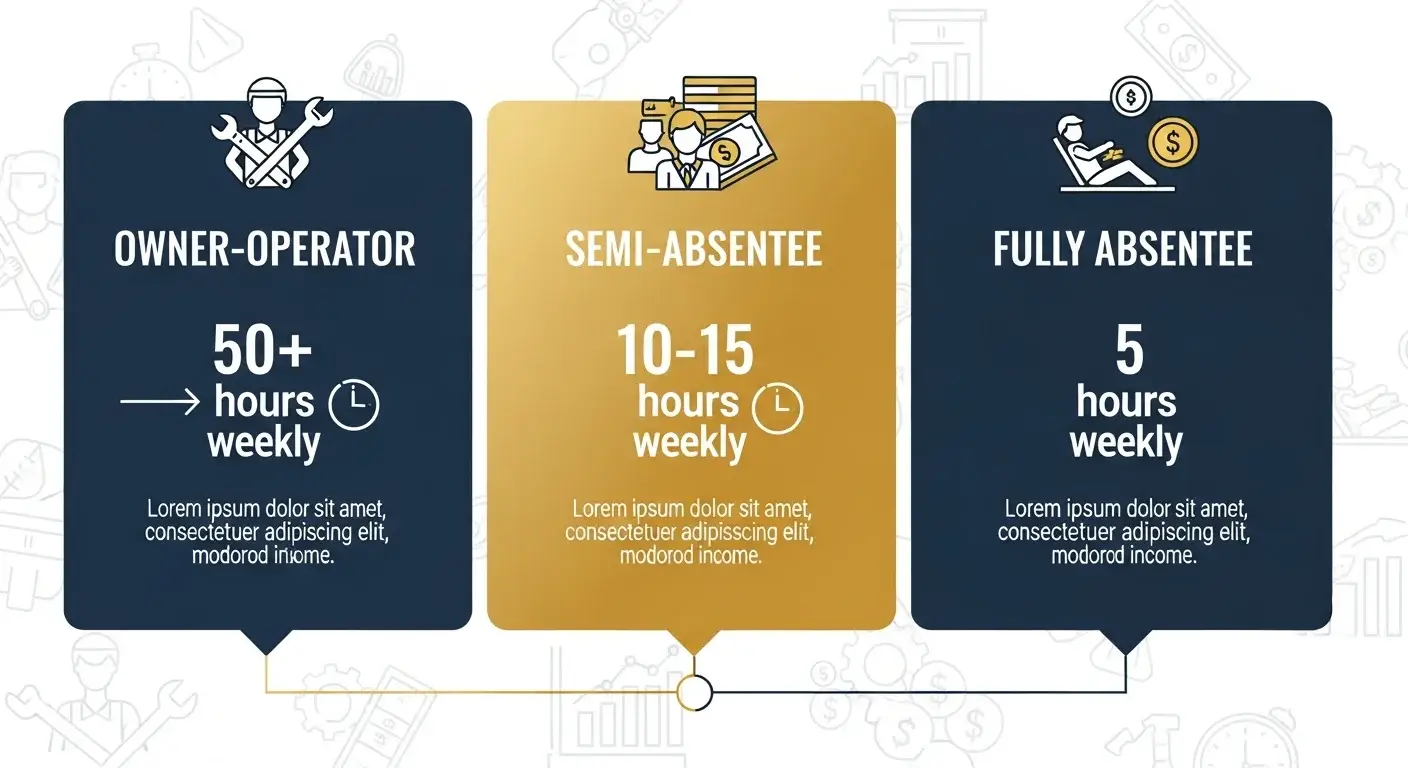
This model sits between two extremes. An owner-operator franchise requires 40-60 hours per week of hands-on work. A fully absentee owner business demands almost zero involvement but offers less control and often lower returns. The semi-absentee model is the middle ground: you stay involved enough to protect your investment and drive growth, but you are not running the register or managing schedules.
Here is what the typical weekly commitment looks like:
| Ownership Model | Weekly Time Commitment | Owner’s Primary Role | Control Level |
|---|---|---|---|
| Owner-Operator | 40-60 hours | Daily management and operations | Full |
| Semi-Absentee | 10-15 hours | Strategic oversight and financial review | High |
| Fully Absentee | 2-5 hours | Passive financial monitoring | Low |
The semi-absentee structure works because of one critical element: a reliable on-site management layer. Without it, the model falls apart. The best semi-absentee franchises build this into their system from the start, rather than leaving you to figure it out on your own.
Why Semi-Absentee Franchising Is a Wealth-Building Strategy
Most people think about franchise ownership as buying a job. Semi-absentee ownership flips that thinking entirely. It is an investment strategy, and when executed correctly, it builds compounding wealth over time.
You Keep Your Primary Income
The most obvious advantage is that you do not have to quit your career. Your salary, benefits, and professional trajectory stay intact. The franchise generates a second income stream that grows independently. This is why the model appeals to corporate professionals, executives, and investors with $500K or more in liquid capital who want to diversify without starting from zero.
You Can Scale to Multiple Units
Once your first location is profitable and your management system is dialed in, you can replicate it. Multi-unit ownership is where the real wealth builds. Each additional location adds revenue without a proportional increase in your time commitment, because the systems, processes, and management playbook are already proven.
In the salon suite industry, this is particularly powerful. A single location generates consistent rental income from dozens of independent beauty professionals. Adding a second or third location multiplies that revenue base while your Concierge Manager at each site handles the day-to-day work.
You Build Equity in Real Assets
A passive income franchise is not just about cash flow. You are building a business asset with real market value. When you are ready to exit, whether that is in 5, 10, or 20 years, you have an asset to sell. This is fundamentally different from purely passive investments like index funds, where you own shares but not a tangible business.
Recession-Resistant Industries Protect Your Downside
Not all franchise categories are equal when it comes to economic durability. The beauty and wellness industry, valued at over $46 billion, has proven remarkably recession-resistant. People continue to prioritize self-care services even during downturns. A salon suite franchise generates rental income from a diversified base of professionals, meaning you are not dependent on a single revenue source.
How to Evaluate a Semi-Absentee Franchise Opportunity
Choosing the right franchise is the most consequential decision you will make. Not every franchise that claims to support absentee ownership actually delivers. Here is a framework for evaluation:
1. Verify the Management Structure
The single most important question: Does the franchise provide a built-in management solution, or are you responsible for finding and training your own manager?
Some franchises hand you a playbook and wish you luck. The best semi-absentee models embed management into the operating system. Salons by JC, for example, places a full-time Concierge Manager at every location. This person manages suite rentals, supports beauty professionals, handles day-to-day operations, and serves as the face of the business. You do not need to recruit, train, or hope you find the right person, because the role is a core part of the franchise model.
This is a genuine differentiator. In most franchise systems, finding a reliable manager is the owner’s biggest challenge and the top reason semi-absentee operations fail. When the franchisor solves that problem for you, it fundamentally changes the risk profile of your investment.
2. Analyze the Unit Economics
Before you invest, you need to understand the real numbers. Request the Franchise Disclosure Document (FDD) and study Item 19, which covers financial performance representations. Key metrics to evaluate:
- Initial investment range — What is the total cost to open, including buildout, equipment, and working capital?
- Time to break-even — How long before the location generates positive cash flow?
- Average unit revenue — What do existing franchisees actually earn?
- Recurring revenue model — Is income based on one-time transactions or ongoing contracts/leases?
Salon suite franchises have a structural advantage here because the revenue model is based on monthly suite rentals. Once suites are occupied, you generate predictable, recurring income. It is closer to commercial real estate than a traditional retail business.
For Salons by JC specifically, the investment ranges from approximately $1.42 million to $2.17 million, with a required net worth of $2 million and $750K in liquid assets. This is a serious investment, and it attracts serious investors who are building long-term wealth.
3. Assess Scalability
The best absentee owner franchises are designed for multi-unit expansion. Ask these questions:
- Does the franchisor offer multi-unit development agreements?
- Are there territory protections for future locations?
- Can the management model support multiple locations efficiently?
- What does the ramp-up timeline look like for second and third units?
A franchise where each location requires your full attention to open is not truly scalable. Look for models where the playbook transfers cleanly from one location to the next.
4. Evaluate Franchisor Support
No franchise is truly “passive.” The franchisor’s support system determines how much of your time gets consumed by problem-solving versus strategic planning. Evaluate:
- Training programs — How comprehensive is initial and ongoing training?
- Marketing support — Does the franchisor handle national marketing and provide local marketing tools?
- Technology systems — Are there dashboards and tools to monitor performance remotely?
- Real estate assistance — Does the franchisor help with site selection and lease negotiation?
Salons by JC provides comprehensive franchisee support including proprietary operational plans, real estate guidance, marketing tools, and the VagaroPlus technology platform for suite renters. This support infrastructure is what allows the semi-absentee model to function without your daily presence.
5. Talk to Existing Franchisees
The FDD is a starting point, but real answers come from existing franchise owners. Ask them:
- How many hours per week do you actually spend on the business?
- How long did it take before you could step back from daily operations?
- What is your biggest challenge as a semi-absentee owner?
- Would you do it again?
Their answers will tell you more than any sales presentation ever could.
The Best Semi-Absentee Franchise Categories in 2026
Certain industries lend themselves to semi-absentee ownership better than others. The common thread is recurring revenue, simple operations, and a business model that does not require the owner’s specialized expertise.
Salon Suites and Beauty Real Estate
This is one of the strongest categories for semi-absentee ownership. The model is straightforward: you lease commercial space, build out individual salon suites, and rent them to licensed beauty professionals. Revenue is recurring and predictable. You do not need any salon or beauty industry experience, because your tenants are the experts.
What makes the salon suite model exceptional for best absentee owner franchises is the simplicity. There is no inventory to manage, no complex supply chain, and no reliance on foot traffic or impulse purchases. Your customers are professionals who sign leases and pay monthly rent.
Fitness and Wellness
Membership-based fitness concepts can work well for semi-absentee owners, particularly those with automated check-in systems and straightforward service delivery. The recurring membership revenue provides stability, though these businesses typically require more staff management than salon suites.
Property-Based Services
Self-storage, car washes, and laundromats share the salon suite model’s advantage of location-based recurring revenue with relatively simple operations. However, capital requirements and real estate complexity vary significantly.
Home Services
Restoration, cleaning, and maintenance franchises can operate semi-absentee with strong dispatch and scheduling systems. These tend to be more operationally complex but offer strong demand fundamentals.
What Your Week Actually Looks Like as a Semi-Absentee Franchise Owner
Let’s be honest about the day-to-day reality. Semi-absentee does not mean absent. Here is a realistic picture of how successful semi-absentee owners spend their 10-15 hours per week:
- Monday (2-3 hours): Review weekly financial dashboard. Check occupancy rates, revenue trends, and any flagged issues from your manager.
- Wednesday (2-3 hours): Strategy call with your Concierge Manager or general manager. Discuss upcoming lease renewals, new renter prospects, marketing initiatives, and any operational needs.
- Friday (1-2 hours): Review marketing performance, approve any spending decisions, and plan for the following week.
- Ongoing (3-5 hours): Quarterly business planning, annual budgeting, franchise network meetings, and relationship building.
During the first 6-12 months, expect to invest significantly more time. You will be involved in site selection, buildout oversight, initial hiring, and the grand opening. This is the foundation-building phase, and cutting corners here undermines everything that follows.
The transition from active involvement to strategic oversight happens gradually. By month 12-18, a well-run semi-absentee franchise should require your attention primarily at the strategic level.
Common Mistakes That Derail Semi-Absentee Franchise Owners
Understanding what goes wrong is just as important as knowing what to do right:
Choosing the Wrong Franchise Model
If the franchise requires your specialized knowledge or daily decision-making, it is not truly semi-absentee regardless of what the marketing materials say. Stick with models that have proven management systems and operational simplicity.
Underestimating the Ramp-Up Period
The first year requires real commitment. Owners who expect to be hands-off from day one almost always struggle. Budget your time accordingly and plan to be more involved upfront.
Hiring the Wrong Manager
If you choose a franchise without a built-in management solution, your success depends entirely on your ability to recruit and retain the right person. This is an enormous risk factor. Models like Salons by JC eliminate this variable by providing an onsite Concierge Manager as part of the franchise system.
Neglecting Financial Oversight
Semi-absentee does not mean unaware. Successful owners review their numbers weekly and understand their key performance indicators cold. The freedom to step back is earned through disciplined financial monitoring, not willful ignorance.
Why Salon Suite Franchising Is the Ideal Semi-Absentee Model

After evaluating dozens of franchise categories, salon suite franchising consistently ranks among the best franchises for passive income for semi-absentee investors. Here is why:
- Recurring rental revenue — Monthly suite leases create predictable, stable cash flow
- No industry expertise required — Your tenants are the beauty professionals; you are the real estate investor
- Low operational complexity — No inventory, no food safety, no complex supply chains
- Built-in demand — Over 1 million licensed beauty professionals in the U.S. are seeking independent suite space
- Recession resistance — Beauty services maintain demand through economic cycles
- Real asset value — You build equity in a tangible business with appreciating value
Salons by JC has refined this model since 1997, earning consistent Entrepreneur 500 recognition and building a national brand that attracts high-quality suite renters. The full-time onsite Concierge Manager at every location is the cornerstone that makes true semi-absentee ownership possible. No other salon suite franchise provides this level of embedded management support.
Frequently Asked Questions
What is the difference between semi-absentee and fully absentee franchise ownership?
A semi-absentee franchise requires 10-15 hours per week of strategic oversight, including financial reviews, manager check-ins, and growth planning. Fully absentee ownership involves minimal involvement, typically just 2-5 hours per week of financial monitoring. Semi-absentee owners maintain more control over their business direction and typically see stronger returns because of their active involvement in strategy.
How much money do I need to invest in a semi-absentee franchise?
Investment requirements vary widely by industry and brand. For a salon suite franchise like Salons by JC, the total initial investment ranges from $1.42 million to $2.17 million, with a required net worth of $2 million and $750K in liquid assets. Lower-cost semi-absentee options exist in home services and vending, but higher-investment models in real estate-based franchises typically offer more stable, recurring revenue.
Can I run a semi-absentee franchise while keeping my full-time job?
Yes, that is one of the primary advantages of the model. Most successful semi-absentee franchise owners maintain their careers while building their franchise portfolio. The key is choosing a franchise with strong management infrastructure so daily operations do not require your presence. Expect to invest more time during the first 12-18 months while systems are being established.
Do I need experience in the industry to own a semi-absentee franchise?
No. The best semi-absentee franchises are specifically designed for investors without industry background. Salons by JC, for example, requires no salon or beauty experience. The franchisor provides comprehensive training, operational systems, and an onsite Concierge Manager who handles the industry-specific aspects of running the business. Your role is business management and investment oversight.
How long before a semi-absentee franchise becomes profitable?
Timelines vary based on location, market conditions, and the specific franchise. Most franchise owners should plan for 12-24 months to reach consistent profitability, with break-even often occurring sooner. Salon suite franchises can reach profitability relatively quickly once occupancy rates stabilize, since the revenue model is based on predictable monthly lease payments. Speak with existing franchisees and review the FDD’s Item 19 for the most accurate performance projections.
Building wealth through franchise ownership starts with choosing the right model. Request a consultation with Salons by JC to learn how the semi-absentee salon suite franchise model can fit your investment strategy.