
Author
Eliana RodriguezPublished
Jul st, 2026Category
BlogChoosing between a franchise and an independent startup shapes the long-term security of your wealth. Every wealth-focused investor must weigh the predictable growth of established systems against the unlimited upside of a custom brand.
Schedule a Discovery Call today with Salons by JC to explore how franchise ownership can accelerate your wealth-building strategy.
An analysis of franchise vs starting own business wealth shows that franchising offers faster cash flow and higher exit potential. In contrast, independent startups provide full equity control without royalty fees.
According to a study by the U.S. Census Bureau, franchises have a 98.3% survival rate in their first year, compared to 92.3% for independent startups. This survival advantage helps franchise owners protect their capital in the critical early years. It also builds an asset that is nearly three times more likely to exit via a sale. In the end, franchising acts as a wealth accelerator with faster cash flow. By contrast, starting from scratch allows you to keep all profits but carries higher initial risk.
Every wealth-focused investor must look past basic startup costs. To make a smart investment, you must study how these two business paths compare across real financial metrics. We compare these paths below, beginning with the most critical metric: survival.
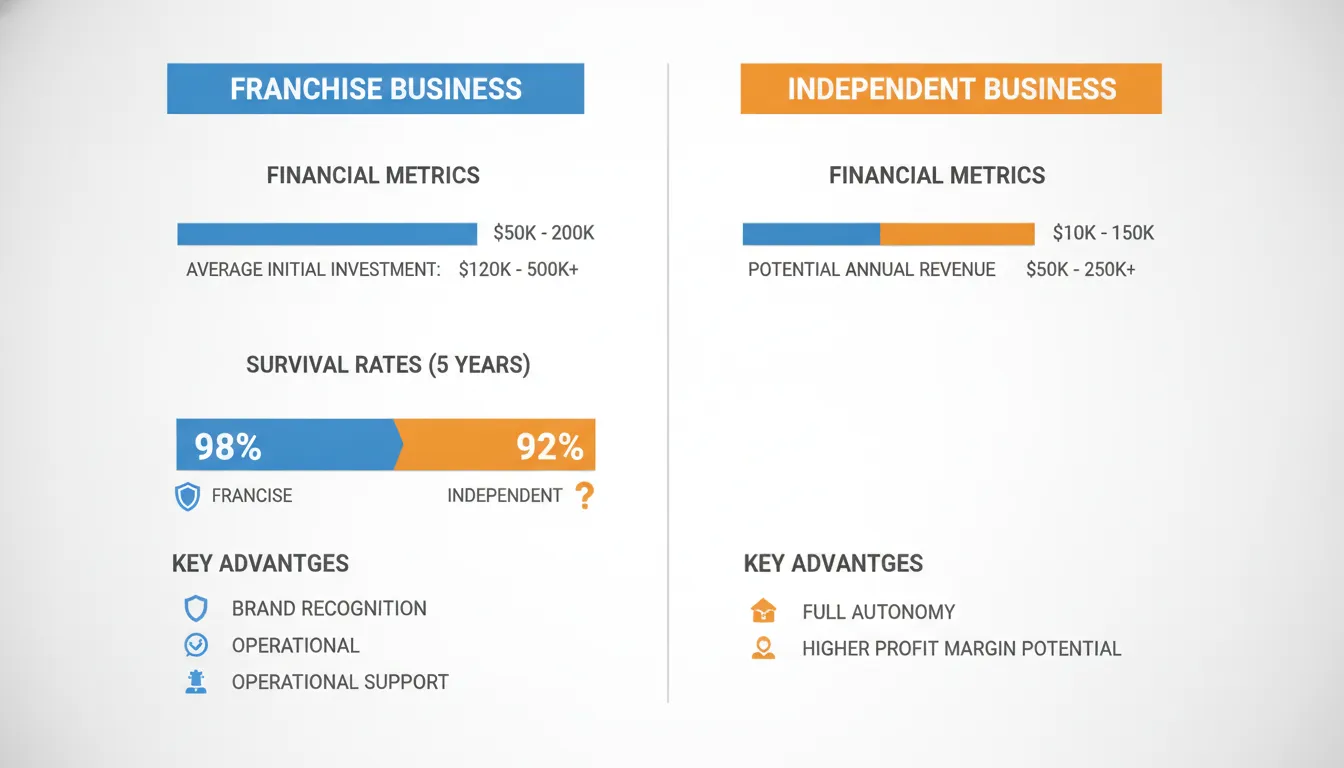
Franchise vs Starting Own Business Wealth: Survival Rates and What the Data Shows
First year survival is a key part of the franchise vs starting own business wealth debate. In their first year, franchises achieve a 98.3% survival rate, while independent startups sit at 92.3%. This is a six percentage point difference that helps secure your initial capital.
Keeping your cash in the first year is vital. If a business fails early, the owner loses all of their initial investment, setting a wealth plan back by many years. A franchise gives a proven blueprint that cuts these early risks. It helps ensure that your money goes toward growth rather than fixing basic setup errors.
The gap in survival rates becomes even more clear over time. According to the SBA Office of Advocacy report, only 49.2% of independent businesses survive for five years. A stable business is the base of any wealth plan. Without steady survival, you cannot build compound returns or grow your assets over the long run.
Long-term growth and exit options
After the first few years, the survival rates for both business types tend to align. An academic study from the University of North Carolina confirms this trend, which you can find in the UNC Greensboro repository. But the study notes that franchise systems have much higher rates of merger and acquisition exits. This means franchise owners can cash out their equity with more ease when they are ready to sell.
A second study from Pepperdine University supports this finding. It shows that franchises are 2.77 times more likely to sell to other firms than independent startups. This exit via sale or merger is a major way to harvest your business wealth. For many owners, this final payout is where they make their largest financial gain.
To reach a great exit, you must focus on early planning. Proper business planning for franchises vs startups will help you map out your financial goals. You will also need to think about how you will fund the business. Looking at franchise financing vs independent funding is a crucial step before you invest your capital. Understanding the key performance indicators for salon suite franchises also helps you measure success against industry benchmarks.
| Metric | Franchise Model | Independent Startup |
|---|---|---|
| First Year Survival | 98.3% survival rate | 92.3% survival rate |
| SBA 5-Year Survival | Higher historical stability | 49.2% survival rate |
| Startup Capital | Predictable fee structure | Unpredictable startup costs |
| Time to Profit | Faster growth via brand power | Slower initial customer base |
| Exit Valuation | High probability of sale | Difficult to transfer or sell |
Revenue Predictability: The Franchise Cash Flow Advantage
When you weigh a franchise vs starting own business wealth, growth depends mostly on how fast your venture can make steady cash flow. Franchises begin with built-in brand value. This brand draw means a franchise can start earning money from day one, not months or years later.
An independent owner must build their name and reputation from the ground up. This demands more time and marketing spend to bring in new customers. For wealth-oriented investors, the earlier cash flow from a franchise can be reinvested faster. This boosts the effect of compounding returns.
Franchise owners also get access to established supplier chains. They can negotiate better pricing than a sole owner. Their operations are refined based on the franchisor’s years of data. An independent owner has to learn by trial and error. These mistakes cost time and money that could have gone into wealth growth.
The International Franchise Association reports that franchising creates stronger jobs and better retention. For a real estate-backed model, the salon suite rental income model demonstrates how recurring tenant revenue provides the predictable monthly cash flow that wealth investors value. By the time an independent startup finds its footing, a franchise may have already expanded to a second location. In the franchise vs starting own business wealth debate, the speed of revenue growth is one of the strongest arguments for buying a franchise.
The Real ROI: What Franchise Fees Mean for Your Wealth Building
When you look at a franchise vs starting own business wealth path, the cost of fees is a major factor. Buying into a brand means paying royalties and ad fees each year. Independent owners keep every dollar of profit, but they must first survive the early years of trial and error.
Consider a franchise paying a 6% royalty plus a 2% ad fee. On $700,000 in annual revenue, that amounts to $56,000 per year. Over a 10-year term, that grows to $560,000 in franchisor payments. This is a real cost that must be weighed against the benefits of the system.
But there is another side to this equation. Brand recognition can accelerate revenue by 8-12 months compared to starting from zero. Those months of faster growth can represent $40,000 to $70,000 in additional revenue. The net present value of that acceleration often covers the first 3-5 years of royalty payments. You are paying for speed, and speed has a measurable value in the franchise vs starting own business wealth calculation.
The most honest way to evaluate royalties is through what analysts call the royalty-to-gross-margin ratio. If your combined royalty and ad fund exceed 20% of your gross margin, the unit economics become tight. Above 30%, you are running the business largely for the franchisor. A salon suite franchise like Salons by JC, with its real estate-backed revenue from tenant rents, operates with healthier margins that keep this ratio in a favorable range.
Visit the Salons by JC investment overview to see how the investment structure compares to other franchise models.
Exit Strategies: How Franchise Ownership Creates Sellable Equity
Wealth is not just about monthly cash flow. True wealth comes when you sell your company for a large payout. When comparing a franchise vs starting own business wealth path, the best chance for a large exit is often with a franchise.
A second study from Pepperdine University supports this finding. It shows that franchises are 2.77 times more likely to sell to other firms than independent startups. This exit via sale or merger is a major way to harvest your business wealth. For many owners, this final payout is where they make their largest financial gain.
Why are franchises easier to sell? A franchise has a proven brand, documented systems, and transferable operations. The next buyer can step in without needing to learn a custom business from scratch. An independent business, by contrast, is often tied to its founder. When the founder leaves, the customer relationships, supplier connections, and operational knowledge leave with them. This founder dependency makes independent businesses harder to market to buyers and lowers their sale price.
Franchisors often maintain a pool of approved buyers or multi-unit operators looking to expand. This built-in buyer network creates a more liquid market for franchise resales. For the wealth-conscious investor, this means you can exit your investment on your timeline rather than waiting years for the right buyer to appear.
The semi-absentee model adds another layer of appeal. A wealth building through semi-absentee ownership strategy allows you to own multiple units without being tied to day-to-day operations, further accelerating your portfolio value.
Semi-Absentee Franchising: Wealth Without Being Behind the Chair
The shift from active work to asset ownership defines the modern franchise investor. Many business owners find that their daily labor is the only thing producing cash flow. If they stop working, the money stops too. A semi-absentee franchise flips this model. You own the business as an asset that produces income through its systems and staff, not through your personal effort.

Here is how the semi-absentee franchise model works as a wealth-building system:
- Invest in a real estate-backed model. Salons by JC model is built on real estate. You lease a commercial space, build out 30-50 private salon suites, and rent them to independent beauty professionals. The suites generate rent revenue, and the Concierge Manager handles all daily operations. This turns your investment into a real estate asset that pays recurring returns.
- Deploy the Concierge Manager system. The Concierge Manager is the core of the semi-absentee model. This full-time on-site manager handles stylist recruitment, suite leasing, maintenance, and customer service. As the owner, you oversee strategic direction without being behind the chair or even in the building every day. After stabilization, most owners spend 10-15 hours per week.
- Achieve stable cash flow through tenant retention. Salons by JC franchise locations maintain a 92% tenant renewal rate. This means once a stylist leases a suite, they tend to stay. Recurring suite rental income creates the predictable cash flow that wealth investors value. The model has been proven across 160+ locations in 26 states with 1,400+ stylists.
- Scale across multiple locations. Because the model does not require your daily presence, the ideal growth path is multi-unit ownership. Each location adds another income stream without adding proportional time commitment. This scalability is the difference between owning a job and owning a portfolio of assets. Review the single unit vs multi unit franchise investment guide to compare your scaling options.
- Exit with a transferable asset. When you are ready to sell, the semi-absentee model shines. A buyer can take over ownership without needing salon experience. The Concierge Manager stays in place, systems run the business, and the real estate asset maintains its value. This makes the location far more marketable than a founder-dependent independent salon.
Learn more about the semi-absentee salon suite franchise model to see how this approach compares with other franchise opportunities.
Due Diligence Checklist for Franchise Wealth Investors
Before committing capital to any franchise opportunity, conduct thorough due diligence. Use this checklist to evaluate whether a franchise supports your wealth-building goals:
- Evaluate Item 19 financial data. Item 19 of the Franchise Disclosure Document contains the franchisor’s financial performance representations. This is the single most important page for wealth-focused buyers. Look for median revenue, gross margins, and the number of units achieving profitability.
- Calculate the royalty-to-gross-margin ratio. A combined royalty and ad fund exceeding 20% of gross margin signals stressed unit economics. Request pro forma financials from the franchisor and model the royalty impact at different revenue levels. If the royalty burden prevents you from building wealth at scale, the franchise may not be the right fit.
- Verify territory protections and growth rights. Wealth building through franchising often depends on multi-unit expansion. Check whether your franchise agreement grants rights of first refusal on adjacent territories. Without clear growth rights, your wealth ceiling is capped at a single location. For models like Salons by JC, the multi-unit path is built into the strategy. Learn more about franchise site selection and territory analysis for salon suite investments.
- Assess the franchisor’s financial health. A franchisor in financial trouble cannot support your wealth building. Review the franchisor’s audited financial statements in Item 21 of the FDD. Look at revenue trends, litigation history, and unit growth over the past three years. A healthy franchisor with a growing system provides a stronger foundation for your investment.
- Model the 10-year wealth projection. Build a simple spreadsheet that projects franchise revenue, royalty costs, operating expenses, and expected sale price at year 10. Compare this against the same projection for an independent startup. Be honest about the higher failure risk of the independent path. The franchise vs starting own business wealth decision ultimately comes down to which projection aligns with your risk tolerance and time horizon.
For a deeper look at the numbers, read our franchise financing vs independent funding guide. Attending a franchise discovery day can also provide valuable face-to-face insight before you commit.
Frequently Asked Questions
Does owning a franchise actually build more wealth than an independent startup?
Owning a franchise can build more wealth by accelerating your path to positive cash flow. A franchise uses a proven brand and operating system to reach scale quickly. Independent startups often face higher risk of failure and slower growth. Research from the U.S. Census Bureau shows a 98.3 percent one-year survival rate for franchises compared to 92.3 percent for independent businesses. This survival advantage helps secure your initial capital and builds long-term equity.
Is franchising lower risk than starting your own business?
Franchising is often seen as a de-risked process rather than a low-risk option. You receive a structured blueprint that avoids many startup mistakes. However, franchise owners must still manage market demand and running costs. An academic paper using the Kauffman Firm Survey found that while franchises start with more capital, their long-term survival rates are similar to independent startups. Franchises reduce early risk but need strong local leadership to build lasting wealth.
How do royalty fees impact long-term wealth in franchising?
Royalty fees are ongoing costs paid to the brand that can reduce your monthly profit margins. These fees often range from five to ten percent of your gross sales. In exchange, you get brand power, marketing help, and ongoing support. For a franchise to build wealth, the brand must save you more time and money than you pay in fees. If you want to compare models, you can learn more about franchise financing vs independent funding before you invest.
Does a franchise offer better exit value than an independent business?
Yes, franchises often command higher exit values because their systems are easier to transfer to a new owner. A buyer can step into an active business with proven cash flow and brand awareness. Independent businesses depend heavily on the original owner, which makes them harder to sell. Research shows franchises have a higher rate of merger and acquisition exits. This makes it easier to cash out and capture your built-up wealth.
Ready to Explore Franchise Wealth Building?
Choosing between a franchise and an independent business is one of the most consequential wealth decisions you will make. If you value speed to revenue, proven systems, and a clear exit path, franchise ownership offers a structured route to building sellable equity.
Salons by JC Franchising pairs the wealth-building advantages of franchising with a real estate-backed semi-absentee model. You own the asset. Your Concierge Manager runs the operation. And you build equity in a business with a 92% tenant renewal rate across 160+ locations nationwide.
Call (210) 314-3126 or visit our Investment Overview to learn if franchise ownership is your path to lasting wealth.