
Author
Eliana RodriguezPublished
Jun th, 2026Category
GuidesFor a semi-absentee investor, salon suite franchise technology is not merely an administrative convenience. It is the operating control layer that turns leasing activity, recurring rent, service requests, and local execution into information an owner can evaluate without being onsite every day.
Request information about Salons by JC Franchising and its semi-absentee operating model.
A salon suite technology stack connects leasing, payments, communication, access, and reporting. The strongest stack reduces manual work, preserves an audit trail, and gives an owner timely visibility into occupancy, collections, exceptions, and tenant support.
The real due diligence question is not whether a franchise uses software. Nearly every concept does. Investors should determine whether the systems create reliable operating leverage, whether data moves cleanly between them, and whether managers can resolve exceptions without creating hidden dependence on the owner.
What is a salon suite franchise technology stack?
A salon suite franchise technology stack is the group of digital systems used to manage the location as a rental-based operating business. It should support the full tenant lifecycle, from an initial suite inquiry and tour through lease execution, recurring payment, renewal, and eventual turnover. It should also help the local team manage facilities, communicate consistently, and escalate issues.
This differs from the software an individual beauty professional may use to schedule appointments or process client payments. The franchisee’s stack is primarily concerned with occupancy, recurring rental revenue, location-level costs, tenant experience, and operational risk. Tenant-facing tools can still matter because they may strengthen the overall value proposition, but investors should evaluate the two layers separately.
The control layer for a semi-absentee owner
For an owner who is not onsite daily, the stack must answer a small set of important questions quickly. How many suites are occupied? Which leases approach renewal? Are scheduled payments arriving? What exceptions require attention? Which local tasks remain unresolved? A dashboard is useful only when its source data is complete, current, and tied to a clear operating process.
Salons by JC Franchising describes a model supported by training, a Concierge Manager, and ongoing franchisee support. Prospective investors can review the broader Salons by JC operating model to understand how technology fits alongside people and process. Technology should make accountability visible. It does not replace capable local management or sound owner judgment.
Integration matters more than the number of tools
A long software list can create the appearance of sophistication while increasing operational friction. Every duplicate record, manual export, and disconnected login creates another opportunity for delay or error. Investors should favor a stack with clear systems of record, defined ownership, and practical integration between leasing, billing, and reporting.
The objective is not complete automation. The objective is controlled execution. Routine events should move automatically, while unusual events should reach the right person with enough context to make a decision.
Leasing technology should protect occupancy economics
Occupancy is a primary driver in a suite-rental model, so leasing technology should do more than store contact information. It should make the conversion pipeline measurable, preserve follow-up discipline, and expose where prospective tenants stop moving forward.
Lead capture and pipeline visibility
A useful leasing workflow records the lead source, desired move-in timing, service specialty, tour status, follow-up activity, and outcome. With that structure, an owner can compare lead volume with tours, applications, signed agreements, and move-ins. This provides a more decision-ready view than a simple count of new inquiries.
During due diligence, ask whether the system can distinguish a demand problem from an execution problem. Low inquiry volume may require more local marketing. Strong inquiry volume with few tours may point to slow follow-up. Many tours with few signed agreements may indicate a positioning, pricing, or qualification issue. The right data helps the owner allocate attention and capital more intelligently.
Renewal and vacancy planning
Leasing systems should surface upcoming expirations early enough for the local team to begin renewal conversations or prepare a vacancy plan. Owners should be able to view near-term exposure by suite, expected move-out dates, and follow-up status. This turns renewal management into a predictable workflow rather than a last-minute reaction.
Investors should also examine how the platform handles documents, version history, approval authority, and access permissions. Lease data contains commercially sensitive information. A sound system should make it clear who can view, change, approve, and export each record.
Payment systems should make exceptions visible
Recurring rent collection is central to the model, but automation alone does not create financial control. A strong payment workflow should reconcile scheduled charges with actual receipts, identify failed or late payments, record adjustments, and preserve a usable audit trail.
From collection automation to cash visibility
Automated billing can reduce repetitive administrative work and make payment timing more consistent. For an investor, the higher-value feature is visibility into exceptions. A concise report should show what was expected, what arrived, what failed, what was waived or adjusted, and what remains unresolved.
Ask how payment data reaches accounting and management reporting. If the local team must repeatedly rebuild reports in spreadsheets, the stack may hide as much work as it removes. The best workflow has a documented reconciliation process and assigns responsibility for every exception.
Controls, permissions, and auditability
Investors should understand who can issue credits, change payment terms, edit tenant records, and export financial data. Role-based permissions reduce the chance that a convenient shortcut becomes a control weakness. Activity logs make it easier to review unusual transactions and coach the local team.
Salons by JC Franchising identifies rent collection, accounting systems, financial reporting, and KPI tracking among the areas addressed through its franchisee support and training. Prospective franchisees should confirm current system details, costs, and responsibilities during formal due diligence.
Communication tools should turn requests into accountable work
Unstructured group chats are fast, but they are poor systems of record. A facilities issue, tenant question, or leasing follow-up can disappear in a busy message thread. Effective salon suite franchise technology routes each request into an owned workflow with a status, due date, and escalation path.
Separate announcements, conversations, and tasks
Different communications serve different purposes. General announcements may need broad distribution and acknowledgment. A maintenance request needs an owner, a priority, and a resolution record. A sensitive tenant matter may require restricted access. Investors should look for a communication model that supports these distinctions without overwhelming the local team.
Templates can improve consistency for routine events such as tour follow-up, move-in preparation, payment reminders, and renewal outreach. However, automation should not make communication feel impersonal or send messages without context. The local manager should be able to pause, edit, or escalate a workflow when circumstances warrant it.
Use service data as an operating signal
When requests are categorized and tracked, they become more than a to-do list. Repeated maintenance issues may reveal a vendor or asset problem. Slow response times may indicate unclear ownership. A rise in similar tenant questions may show where onboarding or documentation needs improvement. This is how routine operating data becomes a source of management insight.
How does technology support semi-absentee oversight?
Technology supports semi-absentee oversight by consolidating performance signals, assigning routine work, and escalating exceptions. It gives the owner a structured review rhythm while the local manager handles day-to-day execution.
Semi-absentee does not mean passive. An owner remains responsible for leadership, financial review, risk decisions, and the performance of the local team. The technology stack should make those responsibilities easier to fulfill with better information and fewer avoidable interruptions.
Build an exception-based dashboard
An investor dashboard should prioritize decisions, not activity volume. Useful indicators may include occupancy, leasing pipeline movement, upcoming renewals, payment exceptions, open service requests, and follow-up completion. Each indicator should have a definition, a source, an accountable owner, and a threshold that triggers action.
A polished chart has little value if nobody trusts the underlying data. During evaluation, ask how often records are updated, how errors are corrected, and whether the same metric is defined consistently across locations. Multi-unit owners especially need comparable information if they intend to allocate resources across a portfolio.
Create a weekly operating cadence
Technology becomes operating leverage when it supports a repeatable management rhythm. A weekly owner review might cover occupancy risk, leasing pipeline, collections exceptions, unresolved requests, local marketing activity, and upcoming decisions. The Concierge Manager can prepare context and recommendations before the meeting, allowing the owner to focus on priorities rather than reconstructing events.
This people-process-technology balance is a defining consideration for anyone evaluating semi-absentee franchise ownership. Prospective owners should assess the management role honestly and confirm expectations directly with Salons by JC Franchising.
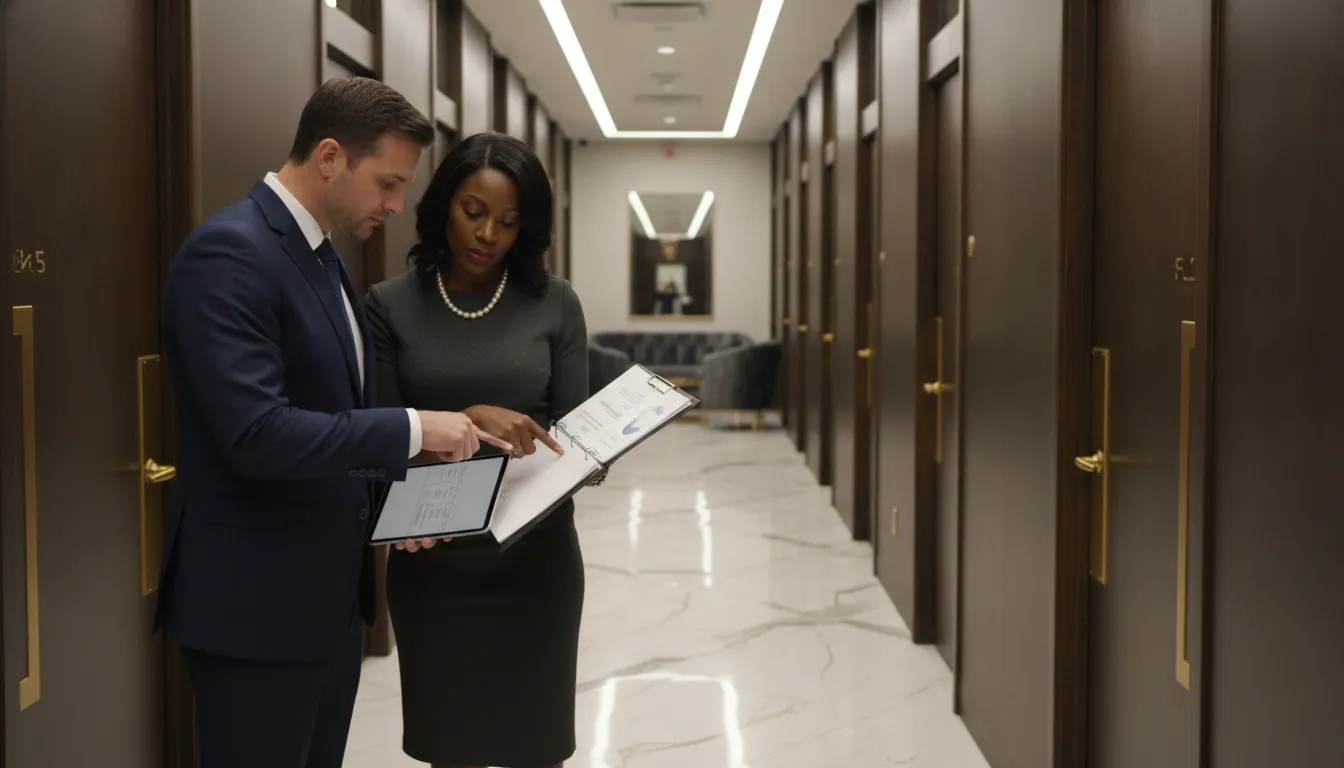
A technology evaluation checklist for franchise investors
A disciplined evaluation connects product features to operating outcomes. Instead of asking only whether a feature exists, ask who uses it, how often it is used, what decision it supports, and what happens when it fails.
| Area | Questions to ask | Evidence to request |
|---|---|---|
| Leasing | Can the team track inquiry-to-move-in conversion and upcoming renewals? | Sample pipeline, renewal report, and follow-up workflow |
| Payments | How are scheduled charges, receipts, failures, and adjustments reconciled? | Exception report, permission model, and audit log |
| Communication | Can requests be assigned, prioritized, escalated, and closed? | Sample task history and escalation rules |
| Reporting | Are metrics current, consistent, and useful for decisions? | Dashboard definitions and source-of-truth map |
| Security | Who can access, change, approve, and export sensitive data? | Role matrix, activity log, and recovery process |
| Scalability | Can the same controls support multiple locations without excessive manual work? | Multi-unit reporting and onboarding process |
Evaluate total operating cost
Software cost includes more than subscription fees. Investors should account for implementation, data migration, training, support, integrations, payment processing, replacement of disconnected tools, and the time required to maintain accurate records. A lower-priced platform may be expensive if it creates recurring manual work.
Test the failure modes
Due diligence often focuses on the ideal demonstration. Investors should also ask what happens when a payment fails, an integration stops syncing, a manager leaves, a device is lost, or an owner needs to revoke access. Resilience, support responsiveness, and data portability matter because operating systems are most valuable when conditions are imperfect.
How should investors assess technology during due diligence?
Start with the operating model, then examine the tools. A franchise concept should be able to explain which work belongs to the owner, which work belongs to local management, which work is automated, and how performance is reviewed. Software cannot compensate for ambiguous accountability.
- Map the tenant lifecycle. Follow a realistic scenario from initial inquiry through move-in, recurring rent, service requests, renewal, and move-out.
- Trace the data. Identify the system of record for tenant, lease, payment, and operational information.
- Review the controls. Confirm permissions, approvals, audit logs, backup practices, and escalation paths.
- Observe actual workflows. Ask to see representative reports and understand how managers use them during a normal week.
- Confirm the commercial terms. Review included technology, optional tools, processing fees, implementation obligations, and future upgrade considerations in current franchise documents.
Prospective investors should use the current Franchise Disclosure Document and conversations with Salons by JC Franchising as the authoritative sources for system requirements, financial qualifications, fees, and obligations. Public articles are useful for framing questions, but they do not replace formal diligence or professional advice.
Review the Salons by JC franchise investment overview alongside the technology assessment. The right decision connects operational capability with capital requirements, local market opportunity, management capacity, and long-term portfolio goals.
Frequently asked questions
What technology is included in a salon suite franchise?
The included technology varies by franchise system and may change over time. Prospective investors should ask for a current list of required and optional platforms, associated fees, implementation responsibilities, integrations, support channels, and data ownership terms.
Can technology make a salon suite franchise passive?
No technology makes business ownership passive. A well-designed stack can automate routine work, improve visibility, and support local management. The owner still needs to review performance, lead the team, make decisions, and manage risk.
Which metrics matter most for semi-absentee oversight?
Useful metrics typically include occupancy, leasing pipeline movement, upcoming renewals, collection exceptions, open service requests, and completion of important follow-ups. Each metric should connect to a decision or defined action.
What should a multi-unit investor prioritize?
A multi-unit investor should prioritize consistent definitions, consolidated reporting, role-based permissions, repeatable onboarding, and workflows that can scale without multiplying manual work. The ability to compare locations reliably is especially important.
Evaluate the model behind the technology
A strong technology stack should make the economics and responsibilities of the business easier to understand. It should help local managers execute consistently and give owners the evidence needed to intervene at the right time. For a sophisticated investor, that is the standard: not more software, but better control, clearer accountability, and scalable operating insight.